Approximation
2S
to 3N
(triggered by cycle-discussion in the Collatz-problem)
a large scale view; N = 1..1038
; a hullcurve N=1…10250
and some more data up to an assumed cycle length of N~10680 000
1. A large-scale view into the distance of 3N and the next perfect power of 2
1.1. The problem
In the investigation of the possibility of cycles under the Collatz-iteration (see [1]), we find, that the length N of such a hypothetic cycle and the distance of 3N to the next greater power 2S is a crucial relation. Here S is defined such that 2S > 3N and more precisely, such that
S = ceil (N log(3)/log(2) )
This relation occurs, if we express the Collatz-transformation in the "syracuse"-notation, such that
T(a) = (3a+1)/2A on odd natural numbers a where the natural number A is such, that the result is again odd
Then N is the number of (syracuse) operations (3ak+1)/2Ak and S is the sum of all occuring exponents Ak.
In the standard notation
C(a)=
3a+1 (if a is odd)
C(a)= a/2 (if a is even),
the variable N indicates the number of odd operations and S is the number of a/2-operations.
If we consider the cycle, we can formulate a condition in terms of an equation which must be solvable in positive integers N,S, .
Example: assume the four consecutive elements a,b,c,d of a cyclic trajectory of N=4 steps in the syracuse-notation (it is obvious how this generalizes to arbitrary N so I just show the toy example here). Then we have that
b
= (3a+1)/2A //
(wlog) we assume "a" as the least element
c = (3b+1)/2B
d = (3c+1)/2C
a = (3d+1)/2D
If we consider the product of the lhs and of the rhs we get
bcda = (3a+1)(3b+1)(3c+1)(3d+1)/2A+B+C+D
Writing S for the sum of exponents and reordering, we get
2S = (3+1/a)(3+1/b)(3+1/c)(3+1/d)
We see, that the rhs becomes 4N when a,b,c,d are all 1, the smallest allowed odd positive integer; and it approaches 3N (from above!) if that elements all tend to infinity. Thus S must lay between ß∙N and 2∙N (where ß=log(3)/log(2)~1.59 ) and the lhs is a perfect power of 2 and must also be greater than 3N , thus at least must be the next perfect power of 2 greater than 3N to allow a N-step cycle. If now the elements a,b,c,d are assumed all to be larger than 1 (to describe another cycle than the trivial), then the rhs tends very fast into the near of 3N, such that it becomes smaller than any 2S (>3N). For instance, for the toy-example using N=4 the rhs becomes bigger than 34=81 but smaller than (3+1/5)4=(16/5)4 =104.8576 and that upper value is smaller than the next perfect power of 2 above 3N (27=128), so we know immediately that there is no 4-step-cycle possible because if we increase the assumed values for a,b,c,d to allowed values the rhs even decreases more. Here the restriction of what is "allowed" is (at least): they must be different, not divisible by 3 , and even more, but which I shall not discuss at the moment.
On the other hand, for some other N we might have the smallest 2S above being nearer, thus some high and special N in combination with not too big members a,b,c,d,... of the assumed cycle might be possible. In the opposite direction, if we know by experimentation, that all a,b,c,... < w are not members of a cycle, where w is the empirically checked highest number then we can formulate
if
for some N and S=ceil(ß∙N)
2S
> (3+1/w)N
then
a cycle with N elements is not possible
The critical inequality can be expressed even more concise
2S
/3N > (1+1/(3w))N
2ceil(ß∙N)-ß∙N > (1+1/(3w))N
ceil(ß∙N)-ß∙N
> N∙ln(1+1/3w)/ln(2)
ln(2)∙(1-frac(ß∙N))
> N∙ln(1+1/(3w))
ln(2)∙(1-frac(ß∙N))/N
> ln(1+1/(3w))
So if for some fixed w and some N under consideration
(1) ln(2)∙(1-frac(ß∙N))/N > ln(1+1/(3w))
we know, that such n N does not allow a cycle, and if
(2) ln(2)∙(1-frac(ß∙N))/N < ln(1+1/(3w))
then a cycle of that length N cannot be excluded/might exist by means of this test only.
For instance, we know that w>20∙258 as shown by T.Oliveira's computational verifications.
If we ask now, what is the minimal N such that (2) is satisfied,
(3) ln(2)∙(1-frac(ß∙N))/N < ln(1+1/(3w)) ~ 5.78241158659 E-20
then we can empirically check for the occurences of the smallest values in the lhs when increasing N. Based on best approximations by the convergents of the continued fractions of ß we get such a picture:

This problem motivated the consideration of the more general problem of the approximatibility of perfect powers of 3 to that of 2 for which I'll provide some data below.
1.2. The function f(N) under consideration and the hullcurve of moving minima
We write 2S to 3N (where N is given and S is the smallest value such that 2S>3N).
I produced data using the arbitrary-precision software Pari/GP.
We are interested in the relative value of that distance (2S-3N)/3N =2S/3N-1, and use the log, because the values of the original function cannot be used with a computer if N itself goes to hundreds or thousand digits.
First we look at
f(N) = log(2S/3N)
=
log(2)*(ceil (N ß ) – N ß)
= log(2)*(
1 - frac (N ß ) )
First few values for f(N) are
log(4/3) = log(1.333..) ~0.287682072452
,
log(16/9) = log(1.7777…) ~ 0.575364144904
log(32/27) ~0.169899036795
(for more values see table in appendix)
The values f(N) range from 0 to log(2)~0.69314 (exclusive the bounds); a "good" approximation (small relative distance) is f(N) near zero, a "bad" approximation is f(N) near log(2). Also "better" approximations occur sporadically with increasing N, but we don't have an easy relation of N to that measure of quality of approximation. So in plot 2 I show a trend, how it appears in a larger scale view for N=1 to 1038 . Then we get a much greater overview for N up to 10680 000 , which means, N has 680 000 digits.
1.3. First impression and the idea of a hullcurve (or envelope)
But before the plot with the trend another, more obvious plot to introduce into the idea of envelope. Here I used N=1 to N=800 and the function-values for each N.
Plot 1: Plot of approximants f(N) for some small N
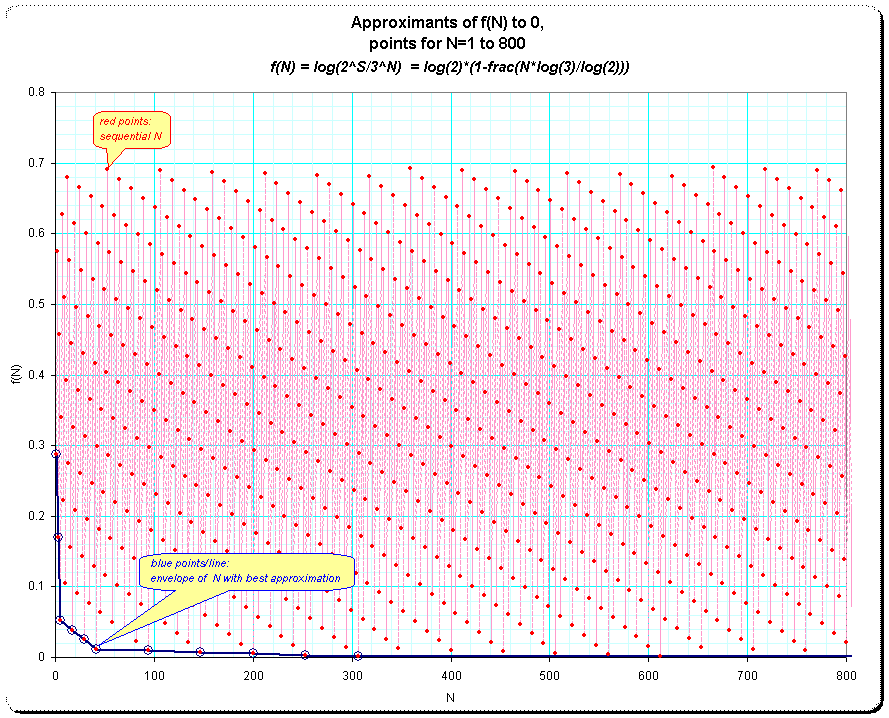
We see a clear regularity ; the apparent antidiagonals of slope ~-45°, for instance, occur, if we increase N in steps by 12 beginning at N=5.
However, if we look at the points nearest the x-axis (y~0), then we see that there is also another cyclicitiness overlaid: we have a very low point at N=41, then the next lower points follow in steps of 53 up to N=306, where the rhythm breaks such that at N=306+53 we have a very high point instead.
This general behave is simply due to modularity of f(N) mod(log(2)). However, it does not lead to exact periodicity of the distances. The reason for this is the irrationality of the ratio ß=log(3)/log(2) and N.
Anyway, for the analysis of the Collatz-problem, namely for the discussion of the "primitive loop" (or "1-cycle") we are interested in the cases of best approximations. We may say, that cycles are "more likely" for length N, if the distance-measure f(N) is small, or near zero. Well: "likeliness" is not really a correct notion for the cycle-discussion, but it gives here an idea, that we are interested in the sharpest approximations depending on N.
So we define a lower envelope for the f(N)-function by connecting the moving minima of the points when increasing N; in the above plot it is indicated by the blue line.
1.4. The lower envelope for f(N)
We are now interested in the characteristic of that envelope.
In the following plot I draw that envelope, whose points were determined using the continued-fraction-representation of log(3)/log(2). That representation gives the points N at which minimal values f(N) occur. That method allows to find relevant N up to N=1038 and its values f(N) in a few seconds, so we get enough points for a good overview. Because we deal with huge values of N and also very small values of f(N) I used a logarithmic scale for both values. (For visual comparision I also inserted sample points for some N which are not on the envelope of local minima)
Plot 2:
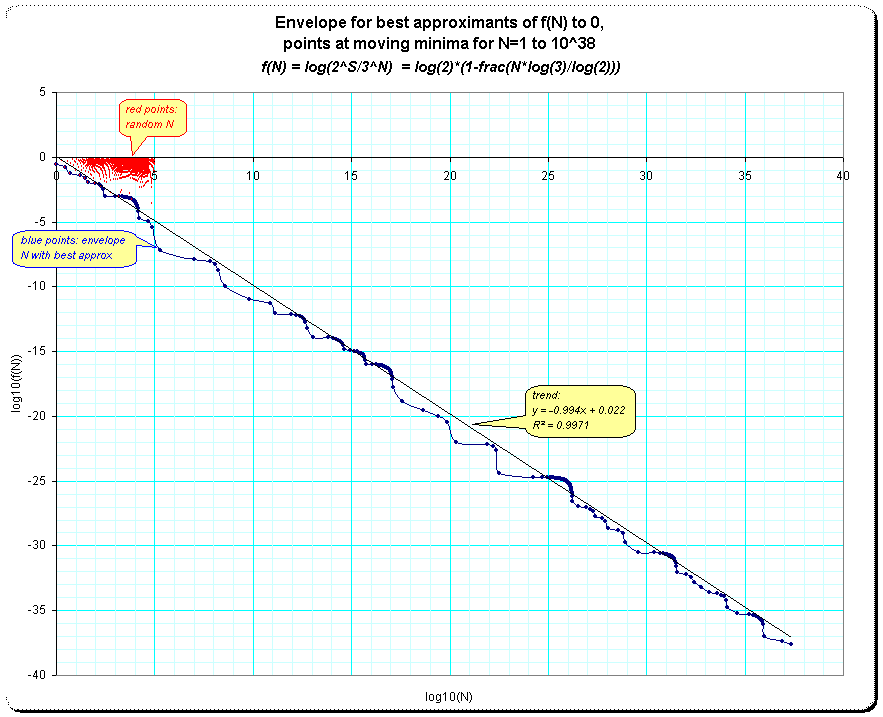
Surprisingly the general tendency of the lower envelope envlow is linear in this log-scales. This information is new to me; I didn't come across a linear ratio of that logarithms before (in [1] I had some logarithmic/polynomial guess bases on much less N).
The long-scale relation between N and envlow(f(N)) is then, using the above equation for the trend, in some different ways of expression:
envlow (log10(f(N)))
~ –0.994 log10(N)
+ 0.022
envlow
(log(f(N))) ~ –
0.994 log(N) + 0.050657
envlow ( f(N) )
~
1.05196 * N-0.994
envlow (2S/3N
) ~
3 2.606/N^0.994
envlow (2S
) ~
3 N+2.606/N^0.994
Note: this does not help for the general cycle. The trend in this formulation is also very raw and rather useless for the actual computation of the upperbound for the smallest member of the general cycle. Such computation should be made on the base of the original computation for each N. In table 2.2 I give some example data for cycle-lengthes N=1 to N=100 instead. That table shows the lower bound for a1 to make a cycle impossible, or said differently: the smallest member of a general cycle must be smaller than the given bound (but all of these small values a1 are easily checked empirically and none is member of a cycle, so cycles of the indicated lengthes cannot exist. For instance, if a1=5 is given, no cycle at all is possible – already alone on the discussed approximation argument).
1.5. More values and another hullcurve
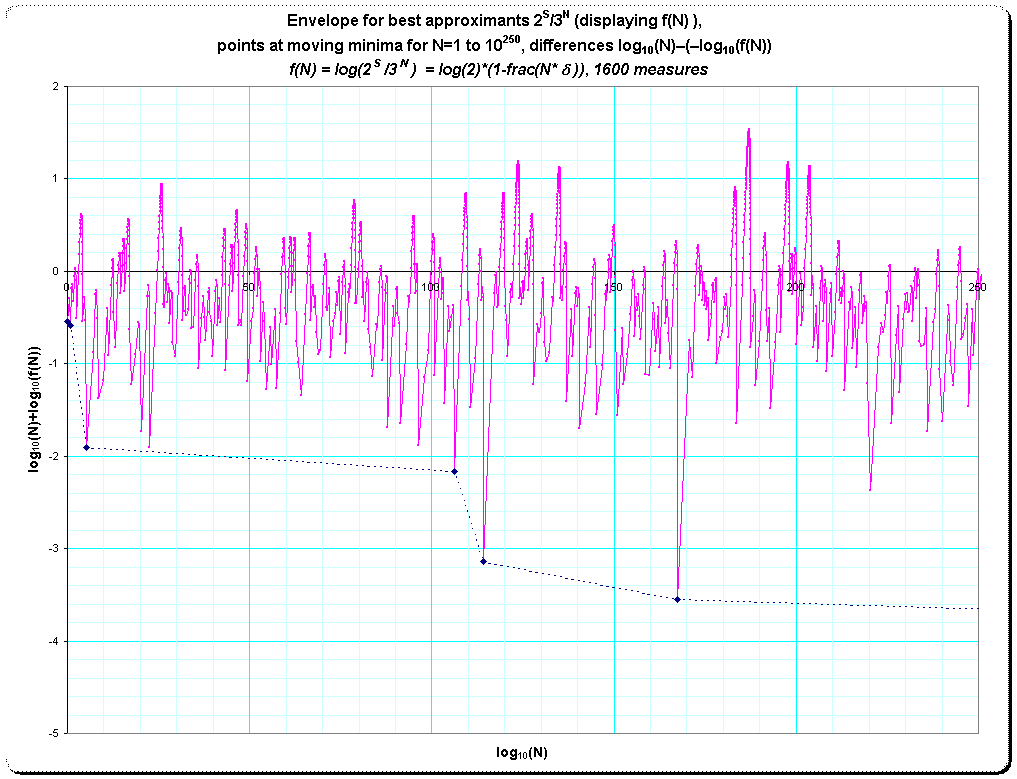
I proceeded using more terms for the hullcurve up to 1600 coordinates which means I arrived at N~10250. Setting precision of computation in Pari/GP to 15000 gives about 14500 entries for the continued fraction of log(3)/log(2). Building the list of convergents gives about 80000 values for N, which gives the coordinates for the hullcurve.
To finally compute with all these values I had then to reduce the precision to 5000 digits (because of memory management) and could effectively check the coordinates up to N~ 102848 distributed in about 25000 entries in that table of convergents. Because log(N) seems in the great overview nearly linear with log(f(N)) I computed the difference of that values log10(N) – (-log10(f(N))) = log10(N*log(2S/3N)) . That differences were in a very near range of about –4 to +5 . However, also here we find nonconstant bounds, so there is again the need of a greater overview: to look at a hullcurve connecting that progressive extrema. Here is the Pari/GP-program and then the few coordinates of that hullcurve.
fmt(15000,12)
cfl = cf_convergentslist(log(3)/log(2));
\\ length(cfl)
\\ %2414 = 14569 \\ number of coefficients of cont.
frac
cf_xopt_chklae( cfl ) \\ check length
when list of convergents were expanded to all N with diminuishing intervals
\\ %2415 = 82099 \\
length of that list, this is too long for current memory allocation!
NList = cf_xopt( cfl , 25000); \\
create list containing all relevant N
\\
allocated memory allows only to work with about 25000 entries
\\ VE(NList,5) \\
do a short check , show the first few entries N
\\ %2417 = [1, 3, 5, 17, 29]~ \\ the first few N (for the exponent of 3^N
according to the list of convergents
fmt(5000,12) \\
precision may be reduced, but must be >2000 (for instance)
[lg10=log(10),lg2=log(2),lg3=log(3),ld3=lg3/lg2] \\ recompute constants with current prec
amin=5;amax=-5; \\
loop to find the moving minima of the deviation-function df(N) = log(N) –
(-log(f(N))
for(k=1, length( NList) ,
N = NList [k]; lgN = log(N) ;
fN = lg2*(1-frac(ld3*N)); lgfN =
log(fN) ;
dfN = lgN – (- lgfN) ;
if( dfN < amin, amin = dfN; \\ if dfN has new minimal value,
register and print values
print(k,"
",lgN/lg10," ",dfN/lg10)) \\
use log to base 10 for more transparent display
)
A shorter procedure is needed if the precision (and by this the length of the continued fractions and from this the integer size of the convergents) is increased above, say fmt(20 000) . For precision with 2 million decimal digits of the log2(3) Pari/GP needed the following procedure.Note that many variables (even temporary ones) are kept as global and outside the function to decrease the memory-requirements in the Pari/GP-stack:
{mkcvgtsN2(maxidx=999)=local(atmp1,atmp2,ui,li,c); \\ maxidx= (#cf>>1)<<1 ;
cfUpHi=cfLoHi=0; ui=li=0;
tmp11=tmp22=1;tmp12=tmp21=0;
forstep(i=1,maxidx,2, \\ if( (i %
10000)==1,print(i));
c=cf[i];
atmp1=1*tmp11+c *tmp12;
atmp2=1*tmp21+c *tmp22;
if(c>cfUpHi,
cfUpHi=c;
ui++;N=NUp[ui]=tmp12+(tmp12==0);IUp[ui]=i;
);
tmp11=tmp12; tmp21=tmp22;
tmp12=atmp1; tmp22=atmp2;
c=cf[i+1];
atmp1=1*tmp11+c *tmp12;
atmp2=1*tmp21+c *tmp22;
if(c>cfLoHi,
cfLoHi=c;
li++;N=NLo[li]=tmp12;if(N==0,N++);ILo[li]=i+1;
);
tmp11=tmp12; tmp21=tmp22;
tmp12=atmp1; tmp22=atmp2;
);
NUp=vecextract(NUp,Str("1..",ui)); IUp=vecextract(IUp,Str("1..",ui));
NLo=vecextract(NLo,Str("1..",li)); ILo=vecextract(ILo,Str("1..",li));
print("ok - NUp,NLo "); }
\\ =========================== end procedures
=====================================================
and then the environment for and the call of that function:
allocatemem(240 000 000)
fmt(2 000 000 );ld3=log(3)/log(2)
cf=contfrac(ld3);
fmt(200); #cf
l2=log(2);l10=log(10);
NUp=NLo=IUp=ILo=vector(2000);
mkcvgtsN2( (#cf >>1) <<1)
{ print("for S > N ");
for(ui=2,#NUp, N=NUp[ui];
print([ui,IUp[ui],
lN=log(N)/l10,
lK=log(l2 *
(1-frac(ld3*N)))/l10 ,
lK1=lN+lK,
lK1+if(lN>0,log(lN)/l10 )
])
)
print("for S < N
");
for(li=1,#NLo, N=NLo[li];
print([li,ILo[li],lN=log(N)/l10,
lK=log(l2 * ( frac(ld3*N)))/l10 ,
lK1=lN+lK,
lK1+if(lN>0,log(lN)/l10 )
])
)
}
Table 1.3: Coordinates for hullcurve characterizing N*f(N) using DN=log10(N * log(2S/3N))=log10(N)+log10(log(2)*(1-{ßN}))
|
index |
index into cf convgts |
log10(N) |
DN=log10(N)–(–log10(f(N))) |
nn= log10(log10(N)) |
dd= |
coeff in cont frac |
index into version 1 list of N |
|
1 |
2 |
0.0 |
-0.541087201293 |
|
|
1 |
1 |
|
2 |
4 |
0.698970004336 |
-0.584058910762 |
-0.1555 |
-0.7396 |
2 |
3 |
|
3 |
14 |
5.27997932298 |
-1.91041044730 |
0.7226 |
-1.1878 |
55 |
37 |
|
4 |
218 |
106.118391607 |
-2.16096110843 |
2.0258 |
-0.1352 |
100 |
542 |
|
5 |
230 |
114.250602011 |
-3.14344653731 |
2.0579 |
-1.0856 |
964 |
597 |
|
6 |
330 |
167.420643539 |
-3.54599907505 |
2.2238 |
-1.3222 |
2 436 |
971 |
|
7 |
528 |
272.363973245 |
-3.67896692796 |
2.4351 |
-1.2438 |
3 308 |
1730 |
|
8 |
2764 |
1407.08628196 |
-3.84754329367 |
3.1483 |
-0.6992 |
4 878 |
9591 |
|
9 |
4312 |
2234.17531188 |
-4.07448957185 |
3.3491 |
-0.7254 |
8 228 |
19795 |
|
10 |
21 150 |
10853.91593 |
-4.934419822 |
4.0356 |
-0.8988 |
59 599 |
-------(*1) |
|
11 |
(*2)122 416 |
63113.10582 |
-5.179259315 |
4.8001 |
-0.3791 |
104 733 |
|
|
12 |
(*3) 396 190 |
204217.496 |
-5.37392218 |
5.3101 |
-0.0638 |
163 963 |
|
|
13 |
771 792 |
397616.664 |
-5.4202135 |
5.5995 |
0.1793 |
182 405 |
|
|
14 |
819 418 |
422115.224 |
-5.6030959 |
5.6254 |
0.0223 |
277 920 |
|
|
15 |
918 630 |
473290.39 |
-5.7783013 |
5.6751 |
-0.1032 |
416 031 |
|
|
15 |
1 228 670 |
632954.726 |
-5.87482624 |
5.8014 |
-0.0735 |
519 578 |
|
|
17 |
1 328 536 |
684406.16 |
-5.92158166 |
5.8353 |
-0.0863 |
578 637 |
|
Note: (*1) (21.Mar 12) I computed the new values by a shorter routine and another list, so the list-index was not comparable
Note: (*2) (21.Sep 12): the length of the cont-frac-coefficients was 193 862 given float precision 200 000 dec digits in Pari/Gp
Note: (*3) (21.Nov 17): the length of the cont-frac-coefficients was 1 940 942 given float precision 2 000 000 dec digits in Pari/Gp
The graphic with the currently farthest view contains several low values of the criterion (blue dots) and the currently best hullcurve for the lowest values (magenta dots/line) taken as piecewise linear graph:

According to this, up to N~1063113.11 (that N has more than 63000 digits) we have
log10(N∙log(2S/3N)
> -5.2
N∙log(2S/3N)
> 10-5.2
log(2S/3N)
> 10-5.2-log10(N) ~ 0.00000662216503702/N
S log(2)-N log(3) > 10-5.2-log10(N)
log(2S/3N)
> 1/(N*105.07 )
where it is not yet recognizable which form (linear, parabolic, logarithmic,…) that hullcurve shows in a even longer scale. (If we use the log10 of log10(N) again, it looks as if we have again a bound roughly linear with that values…)
A more recent heuristic using N up to 10685 000 (that N has more than 685 000 digits) gives
|
|
Guessed optimized functional lower bound log10(N∙log(2S/3N) + log10(log10(N))0.8 > -2 observed
|

We can put now that (newest) heuristic and the condition for a cycle together. Remember, the cycle with N elements a1,a2,...ak,...aN must satisfy the condition
2S = (3 + 1/a1)(3 + 1/a2)...(3 + 1/ak)...(3 + 1/aN)
If we assume that a1 is the smallest element then an upper bound for a1 , dependend on N, can then be determined.
We reduce all ak to the value of a1 then the rhs is surely larger than the original expression. We can then write
2S
< (3 + 1/a1)N
S log(2) < N log (3 +
1/a1) = N log (3) + N log(1 + 1/3/a1)
S log(2) − N log (3)
< N log(1 + 1/3/a1)
For the lhs we have just found a heuristical lower bound such that we can write the concatenated inequality
1/100/N/10^(log10(log10(N))0.8
) < log(2)∙(1-frac(ß∙N))
=S log(2) − N log(3) <
N∙log(1+1/(3a1))
1/100/N/10^(log10(log10(N))0.8
) <
N∙log(1+1/(3a1))
Now we use, that log(1+1/x) is near, but always smaller than 1/x so we look at:
1/100/N/10^(log10(log10(N))0.8
) <
N∙1/(3a1)
a1 < 33.3 N² ∙ 10^(log10(log10(N))0.8
)
and get an upper bound for a1 depending on the length N of a projected cycle. A short table for examples:
|
N |
a1 |
|
10 |
< 3 333.333... |
|
100 |
< 804 645.550972 |
|
1000 |
< 119 153 085.026 |
Of course, for small N like these we can evaluate the upper bound for the smallest member a1 by direct formulae - we simply use
2S
< ( 3+1/a1 ) N
a1 < 1/( 2S/N-3
)
Conversely, if we use the knowledge, that all a1<5∙260 are not member of a nontrivial cycle, then we can compute a lower bound for the length N of a cycle; we get by numerical search
N > 142 793 282 if a1>5∙260
To compare: the best proven lower bound for f(N)= log(2)*S - log(3)*N > 0 seems to be
| f(N) | > e-13.3(0.46057+log(N)) ~ 1/457/N13.3
which is due to G.Rhin (1987) as cited in J. Simons (2007) . Of course, this bound is rather weak; we find, that for a1=5∙260 the length of a cycle must be greater than 14.43 .
The general form is also be described and a bit explained in T. Tao's blog, which results in
| f(N) | > t /S u where S = ceil (N* log(3)/log(2))
Empirically, that exponent u is very near 1 and thus the formula above, having N13.3 in the denominator, is very weak. It can -however- be used for the disproof of the 1-cycle, because the 1-cycle puts hard restrictions on its members which can be nicely exploited for a disproof.
Gottfried Helms, 11'2017 (previous version: 9'2012, 3'2012, 3'2010)
for a overview of the related cycle-discussion ("primitive loop") see:
[1] "cycles in the
collatz-iteration",
G. Helms, 2006-2008
http://go.helms-net.de/math/collatz/Collatz061102.pdf
[2] "disproving the
1-cycle",
G. Helms, 11'2017
http://go.helms-net.de/math/collatz/Collatz_1cycledisproof.pdf
[Simons,2005]Theoretical and computational bounds for
m-cycles of the 3n + 1 problem
J. Simons; Benne de Weger,
Acta Arithmetica, Vol. 117, pp. 51–70, 2005.
Online update 2010 http://deweger.xs4all.nl/papers/%5b35a%5dSidW-3n+1-v1.44%5b2010%5d.pdf
Future updates may appear on http://www.win.tue.nl/∼bdeweger/research.html .
[3] number ß=log(3)/log(2) to 1
million digits, in Pari/GP-textformat
http://go.helms-net.de/math/collatz/ld3.zip
continued fraction of ß to 145 000 coefficients
http://go.helms-net.de/math/collatz/cf32.zip
2. Appendix
How to read the following table:
|
N |
f(N)=log(2^S/3^N) |
log10(N) |
log10(f(N)) |
3^N |
3^N*exp(f(N))=2^S |
|
length of the cycle |
0.287682072452 |
0.000000 |
-0.541087201293 |
3^1 = 3 |
3*exp(f(N))=4 |
|
length of the cycle |
0.169899036795 |
0.477121254720 |
-0.769809083259 |
3^3 = 27 |
27*exp(f(N))=32 |
|
length of the cycle |
0.0521160011390 |
0.698970004336 |
-1.28302891510 |
3^5 =243 |
243*exp(f(N))=256 |
|
17 |
0.0385649677607 |
1.23044892138 |
-1.41380702736 |
… |
… |
2.1. Data for graph of envelope:
|
N |
f(N) |
log10(N) |
log10(f(N)) |
log10(N)+log10(f(N)) |
|
1 |
0.287682072452 |
0.000000 |
-0.541087201293 |
-0.54108720129 |
|
3 |
0.169899036795 |
0.477121254720 |
-0.769809083259 |
-0.29268782854 |
|
5 |
0.0521160011390 |
0.698970004336 |
-1.28302891510 |
-0.58405891076 |
|
17 |
0.0385649677607 |
1.23044892138 |
-1.41380702736 |
-0.18335810598 |
|
29 |
0.0250139343823 |
1.46239799790 |
-1.60181799375 |
-0.13941999585 |
|
41 |
0.0114629010039 |
1.61278385672 |
-1.94070545824 |
-0.32792160152 |
|
94 |
0.00937476862954 |
1.97312785360 |
-2.02803944191 |
-0.05491158831 |
|
147 |
0.00728663625513 |
2.16731733475 |
-2.13747290968 |
0.02984442507 |
|
200 |
0.00519850388072 |
2.30102999566 |
-2.28412162749 |
0.01690836817 |
|
253 |
0.00311037150632 |
2.40312052118 |
-2.50718773525 |
-0.10406721407 |
|
306 |
0.00102223913191 |
2.48572142648 |
-2.99044749802 |
-0.50472607154 |
|
971 |
0.000978585021321 |
2.98721922991 |
-3.00940143604 |
-0.02218220613 |
|
1636 |
0.000934930910732 |
3.21378329934 |
-3.02922048132 |
0.18456281802 |
|
2301 |
0.000891276800144 |
3.36191661867 |
-3.04998739798 |
0.31192922069 |
|
2966 |
0.000847622689555 |
3.47217114669 |
-3.07179742641 |
0.40037372028 |
|
3631 |
0.000803968578966 |
3.56002624891 |
-3.09476092420 |
0.46526532471 |
|
4296 |
0.000760314468378 |
3.63306427269 |
-3.11900674504 |
0.51405752765 |
|
4961 |
0.000716660357789 |
3.69556922704 |
-3.14468661795 |
0.55088260909 |
|
5626 |
0.000673006247200 |
3.75019972783 |
-3.17198090441 |
0.57821882342 |
|
6291 |
0.000629352136612 |
3.79871968519 |
-3.20110628906 |
0.59761339613 |
|
6956 |
0.000585698026023 |
3.84235957333 |
-3.23232623967 |
0.61003333366 |
|
7621 |
0.000542043915434 |
3.88201196163 |
-3.26596552627 |
0.61604643536 |
|
8286 |
0.000498389804846 |
3.91834492896 |
-3.30243085027 |
0.61591407869 |
|
8951 |
0.000454735694257 |
3.95187155713 |
-3.34224095472 |
0.60963060241 |
|
9616 |
0.000411081583668 |
3.98299445466 |
-3.38607197905 |
0.59692247561 |
|
10281 |
0.000367427473080 |
4.01203535915 |
-3.43482837399 |
0.57720698516 |
|
10946 |
0.000323773362491 |
4.03925544381 |
-3.48975888442 |
0.54949655939 |
|
11611 |
0.000280119251902 |
4.06486962506 |
-3.55265704217 |
0.51221258289 |
|
12276 |
0.000236465141314 |
4.08905687976 |
-3.62623287205 |
0.46282400771 |
|
12941 |
0.000192811030725 |
4.11196783721 |
-3.71486812372 |
0.39709971349 |
|
13606 |
0.000149156920136 |
4.13373046662 |
-3.82635659274 |
0.30737387388 |
|
14271 |
0.000105502809548 |
4.15445440614 |
-3.97673597492 |
0.17771843122 |
|
14936 |
0.0000618486989592 |
4.17423430494 |
-4.20866943170 |
-0.03443512676 |
|
15601 |
0.0000181945883705 |
4.19315243685 |
-4.74005776533 |
-0.54690532848 |
|
47468 |
0.0000109296545229 |
4.67640093369 |
-4.96139356551 |
-0.28499263182 |
|
79335 |
0.00000366472067521 |
4.89946482607 |
-5.43595912166 |
-0.53649429559 |
|
190537 |
0.0000000645075027718 |
5.27997932298 |
-7.19038977028 |
-1.91041044730 |
|
10781274 |
0.0000000122069827808 |
7.03267008353 |
-7.91339166804 |
-0.88072158451 |
|
64497107 |
0.00000000873439391323 |
7.80954023491 |
-8.05876722569 |
-0.24922699078 |
|
118212940 |
0.00000000526180504562 |
8.07266501853 |
-8.27886524693 |
-0.20620022840 |
|
171928773 |
0.00000000178921617802 |
8.23534856377 |
-8.74733718361 |
-0.51198861984 |
|
397573379 |
1.05843488432E-10 |
8.59941729690 |
-9.97533585493 |
-1.37591855803 |
|
6586818670 |
1.01231253207E-11 |
9.81867570782 |
-10.9946853867 |
-1.17600967888 |
|
72057431991 |
5.51089009577E-12 |
10.8576787805 |
-11.2587782501 |
-0.40109946960 |
|
137528045312 |
8.98654870862E-13 |
11.1383912704 |
-12.0464070674 |
-0.90801579700 |
|
890638885193 |
7.79694000263E-13 |
11.9497016525 |
-12.1080758077 |
-0.15837415520 |
|
1643749725074 |
6.60733129664E-13 |
12.2158356932 |
-12.1799739168 |
0.03586177640 |
|
2396860564955 |
5.41772259065E-13 |
12.3796427701 |
-12.2661832364 |
0.11345953370 |
|
3149971404836 |
4.22811388467E-13 |
12.4983066113 |
-12.3738533234 |
0.12445328790 |
|
3903082244717 |
3.03850517868E-13 |
12.5914077027 |
-12.5173400191 |
0.07406768360 |
|
4656193084598 |
1.84889647269E-13 |
12.6680309815 |
-12.7330874061 |
-0.06505642460 |
|
5409303924479 |
6.59287766701E-14 |
12.7331413832 |
-13.1809249827 |
-0.44778359950 |
|
11571718688839 |
1.28966827413E-14 |
13.0633978673 |
-13.8895219837 |
-0.82612411640 |
|
64021008208555 |
1.14513197778E-14 |
13.8063225092 |
-13.9411444575 |
-0.13482194830 |
|
116470297728271 |
1.00059568144E-14 |
14.0662151856 |
-13.9997413759 |
0.06647380970 |
|
168919587247987 |
8.56059385088E-15 |
14.2276800116 |
-14.0674961071 |
0.16018390450 |
|
221368876767703 |
7.11523088740E-15 |
14.3451165614 |
-14.1478110026 |
0.19730555880 |
|
273818166287419 |
5.66986792391E-15 |
14.4374622577 |
-14.2464270576 |
0.19103520010 |
|
326267455807135 |
4.22450496043E-15 |
14.5135737564 |
-14.3742241756 |
0.13934958080 |
|
378716745326851 |
2.77914199695E-15 |
14.5783145083 |
-14.5560892629 |
0.02222524540 |
|
431166034846567 |
1.33377903347E-15 |
14.6346445419 |
-14.8749161138 |
-0.24027157190 |
|
914781359212850 |
1.22219510347E-15 |
14.9613173063 |
-14.9128594605 |
0.04845784580 |
|
1398396683579133 |
1.11061117346E-15 |
15.1456303853 |
-14.9544379616 |
0.19119242370 |
|
1882012007945416 |
9.99027243451E-16 |
15.2746223901 |
-15.0004226684 |
0.27419972170 |
|
2365627332311699 |
8.87443313444E-16 |
15.3739463294 |
-15.0518593785 |
0.32208695090 |
|
2849242656677982 |
7.75859383436E-16 |
15.4547294376 |
-15.1102169830 |
0.34451245460 |
|
3332857981044265 |
6.64275453429E-16 |
15.5228168080 |
-15.1776517955 |
0.34516501250 |
|
3816473305410548 |
5.52691523421E-16 |
15.5816622290 |
-15.2575171961 |
0.32414503290 |
|
4300088629776831 |
4.41107593414E-16 |
15.6334774070 |
-15.3554554660 |
0.27802194100 |
|
4783703954143114 |
3.29523663407E-16 |
15.6797642949 |
-15.4821133929 |
0.19765090200 |
|
5267319278509397 |
2.17939733399E-16 |
15.7215896439 |
-15.6616635847 |
0.05992605920 |
|
5750934602875680 |
1.06355803392E-16 |
15.7597384290 |
-15.9732388075 |
-0.21350037850 |
|
11985484530117643 |
1.01127676776E-16 |
16.0786555957 |
-15.9951299698 |
0.08352562590 |
|
18220034457359606 |
9.58995501609E-17 |
16.2605491940 |
-16.0181834300 |
0.24236576400 |
|
24454584384601569 |
9.06714235454E-17 |
16.3883602862 |
-16.0425295658 |
0.34583072040 |
|
30689134311843532 |
8.54432969300E-17 |
16.4869846379 |
-16.0683220022 |
0.41866263570 |
|
36923684239085495 |
8.02151703145E-17 |
16.5673050283 |
-16.0957434901 |
0.47156153820 |
|
43158234166327458 |
7.49870436990E-17 |
16.6350636671 |
-16.1250137678 |
0.51004989930 |
|
49392784093569421 |
6.97589170835E-17 |
16.6936635065 |
-16.1564002699 |
0.53726323660 |
|
55627334020811384 |
6.45307904680E-17 |
16.7452882466 |
-16.1902330150 |
0.55505523160 |
|
61861883948053347 |
5.93026638525E-17 |
16.7914231419 |
-16.2269257979 |
0.56449734400 |
|
68096433875295310 |
5.40745372370E-17 |
16.8331243691 |
-16.2670071885 |
0.56611718060 |
|
74330983802537273 |
4.88464106215E-17 |
16.8711698809 |
-16.3111673440 |
0.56000253690 |
|
80565533729779236 |
4.36182840061E-17 |
16.9061492886 |
-16.3603314241 |
0.54581786450 |
|
86800083657021199 |
3.83901573906E-17 |
16.9385201437 |
-16.4157801074 |
0.52274003630 |
|
93034633584263162 |
3.31620307751E-17 |
16.9686446515 |
-16.4793588820 |
0.48928576950 |
|
99269183511505125 |
2.79339041596E-17 |
16.9968144498 |
-16.5538683612 |
0.44294608860 |
|
105503733438747088 |
2.27057775441E-17 |
17.0232678282 |
-16.6438636214 |
0.37940420680 |
|
111738283365989051 |
1.74776509286E-17 |
17.0482019950 |
-16.7575169388 |
0.29068505620 |
|
117972833293231014 |
1.22495243131E-17 |
17.0717820098 |
-16.9118807760 |
0.15990123380 |
|
124207383220472977 |
7.02139769766E-18 |
17.0941474122 |
-17.1535764275 |
-0.05942901530 |
|
130441933147714940 |
1.79327108217E-18 |
17.1154172264 |
-17.7463540548 |
-0.63093682840 |
|
397560349370386783 |
1.51686631025E-19 |
17.5994030636 |
-18.8190526943 |
-1.21964963070 |
|
4640282259296926456 |
2.69684901278E-20 |
18.6665443986 |
-19.5691433675 |
-0.90259896890 |
|
27444133206411171953 |
1.01243097420E-20 |
19.4384495186 |
-19.9946345766 |
-0.55618505800 |
|
77692117359936589403 |
3.40443909807E-21 |
19.8903769575 |
-20.4679544305 |
-0.57757747300 |
|
205632218873398596256 |
8.90075522457E-23 |
20.3130911618 |
-22.0505731421 |
-1.73748198030 |
|
7941964418702608664581 |
6.68554395133E-23 |
21.8999279370 |
-22.1748632518 |
-0.27493531480 |
|
15678296618531818732906 |
4.47033267809E-23 |
22.1952988766 |
-22.3496601559 |
-0.15436127930 |
|
23414628818361028801231 |
2.25512140485E-23 |
22.3694872775 |
-22.6468300728 |
-0.27734279530 |
|
31150961018190238869556 |
3.99101316135E-25 |
22.4934714493 |
-24.3989168400 |
-1.90544539070 |
|
1752190149218482586763461 |
1.97560971162E-25 |
24.2435812344 |
-24.7042988476 |
-0.46071761320 |
|
5225419486637257521420827 |
1.93581597351E-25 |
24.7181211605 |
-24.7131359309 |
0.00498522960 |
|
8698648824056032456078193 |
1.89602223540E-25 |
24.9394517982 |
-24.7221565738 |
0.21729522440 |
|
12171878161474807390735559 |
1.85622849729E-25 |
25.0853575965 |
-24.7313685642 |
0.35398903230 |
|
15645107498893582325392925 |
1.81643475919E-25 |
25.1943785516 |
-24.7407801961 |
0.45359835550 |
|
19118336836312357260050291 |
1.77664102108E-25 |
25.2814501090 |
-24.7504003146 |
0.53104979440 |
|
22591566173731132194707657 |
1.73684728297E-25 |
25.3539463397 |
-24.7602383664 |
0.59370797330 |
|
26064795511149907129365023 |
1.69705354486E-25 |
25.4160543221 |
-24.7703044548 |
0.64574986730 |
|
29538024848568682064022389 |
1.65725980675E-25 |
25.4703814515 |
-24.7806094024 |
0.68977204910 |
|
33011254185987456998679755 |
1.61746606865E-25 |
25.5186620247 |
-24.7911648212 |
0.72749720350 |
|
36484483523406231933337121 |
1.57767233054E-25 |
25.5621082027 |
-24.8019831911 |
0.76012501160 |
|
39957712860825006867994487 |
1.53787859243E-25 |
25.6016006217 |
-24.8130779485 |
0.78852267320 |
|
43430942198243781802651853 |
1.49808485432E-25 |
25.6377992511 |
-24.8244635867 |
0.81333566440 |
|
46904171535662556737309219 |
1.45829111621E-25 |
25.6712114695 |
-24.8361557699 |
0.83505569960 |
|
50377400873081331671966585 |
1.41849737810E-25 |
25.7022357571 |
-24.8481714626 |
0.85406429450 |
|
53850630210500106606623951 |
1.37870364000E-25 |
25.7311907902 |
-24.8605290778 |
0.87066171240 |
|
57323859547918881541281317 |
1.33890990189E-25 |
25.7583354232 |
-24.8732486466 |
0.88508677660 |
|
60797088885337656475938683 |
1.29911616378E-25 |
25.7838827847 |
-24.8863520136 |
0.89753077110 |
|
64270318222756431410596049 |
1.25932242567E-25 |
25.8080104502 |
-24.8998630628 |
0.90814738740 |
|
67743547560175206345253415 |
1.21952868756E-25 |
25.8308679358 |
-24.9138079791 |
0.91705995670 |
|
71216776897593981279910781 |
1.17973494945E-25 |
25.8525823146 |
-24.9282155545 |
0.92436676010 |
|
74690006235012756214568147 |
1.13994121135E-25 |
25.8732624957 |
-24.9431175454 |
0.93014495030 |
|
78163235572431531149225513 |
1.10014747324E-25 |
25.8930025287 |
-24.9585490944 |
0.93445343430 |
|
81636464909850306083882879 |
1.06035373513E-25 |
25.9118841903 |
-24.9745492295 |
0.93733496080 |
|
85109694247269081018540245 |
1.02055999702E-25 |
25.9299790303 |
-24.9911614587 |
0.93881757160 |
|
88582923584687855953197611 |
9.80766258914E-26 |
25.9473500096 |
-25.0084344835 |
0.93891552610 |
|
92056152922106630887854977 |
9.40972520806E-26 |
25.9640528215 |
-25.0264230591 |
0.93762976240 |
|
95529382259525405822512343 |
9.01178782697E-26 |
25.9801369694 |
-25.0451890418 |
0.93494792760 |
|
99002611596944180757169709 |
8.61385044589E-26 |
25.9956466510 |
-25.0648026728 |
0.93084397820 |
|
102475840934362955691827075 |
8.21591306481E-26 |
26.0106214909 |
-25.0853441648 |
0.92527732610 |
|
105949070271781730626484441 |
7.81797568373E-26 |
26.0250971500 |
-25.1069056847 |
0.91819146530 |
|
109422299609200505561141807 |
7.42003830264E-26 |
26.0391058376 |
-25.1295938529 |
0.90951198470 |
|
112895528946619280495799173 |
7.02210092156E-26 |
26.0526767427 |
-25.1535329331 |
0.89914380960 |
|
116368758284038055430456539 |
6.62416354048E-26 |
26.0658364002 |
-25.1788689540 |
0.88696744620 |
|
119841987621456830365113905 |
6.22622615940E-26 |
26.0786090033 |
-25.2057751082 |
0.87283389510 |
|
123315216958875605299771271 |
5.82828877832E-26 |
26.0910166714 |
-25.2344589381 |
0.85655773330 |
|
126788446296294380234428637 |
5.43035139723E-26 |
26.1030796799 |
-25.2651720664 |
0.83790761350 |
|
130261675633713155169086003 |
5.03241401615E-26 |
26.1148166605 |
-25.2982236367 |
0.81659302380 |
|
133734904971131930103743369 |
4.63447663507E-26 |
26.1262447734 |
-25.3339993030 |
0.79224547040 |
|
137208134308550705038400735 |
4.23653925399E-26 |
26.1373798590 |
-25.3729887652 |
0.76439109380 |
|
140681363645969479973058101 |
3.83860187290E-26 |
26.1482365693 |
-25.4158269291 |
0.73240964020 |
|
144154592983388254907715467 |
3.44066449182E-26 |
26.1588284842 |
-25.4633576745 |
0.69547080970 |
|
147627822320807029842372833 |
3.04272711074E-26 |
26.1691682135 |
-25.5167369959 |
0.65243121760 |
|
151101051658225804777030199 |
2.64478972966E-26 |
26.1792674870 |
-25.5776088502 |
0.60165863680 |
|
154574280995644579711687565 |
2.24685234858E-26 |
26.1891372350 |
-25.6484254662 |
0.54071176880 |
|
158047510333063354646344931 |
1.84891496749E-26 |
26.1987876589 |
-25.7330830618 |
0.46570459710 |
|
161520739670482129581002297 |
1.45097758641E-26 |
26.2082282948 |
-25.8383392962 |
0.36988899860 |
|
164993969007900904515659663 |
1.05304020533E-26 |
26.2174680698 |
-25.9775550470 |
0.23991302280 |
|
168467198345319679450317029 |
6.55102824247E-27 |
26.2265153535 |
-26.1836905283 |
0.04282482520 |
|
171940427682738454384974395 |
2.57165443165E-27 |
26.2353780027 |
-26.5897873905 |
-0.35440938780 |
|
347354084702895683704606156 |
1.16393505247E-27 |
26.5407724103 |
-26.9340712526 |
-0.39329884230 |
|
870121826425948596728844073 |
9.20150725772E-28 |
26.9395800628 |
-27.0361410270 |
-0.09656096420 |
|
1392889568149001509753081990 |
6.76366399071E-28 |
27.1439166858 |
-27.1698179757 |
-0.02590128990 |
|
1915657309872054422777319907 |
4.32582072370E-28 |
27.2823178212 |
-27.3639314831 |
-0.08161366190 |
|
2438425051595107335801557824 |
1.88797745669E-28 |
27.3871094115 |
-27.7240031957 |
-0.33689378420 |
|
5399617844913267584627353565 |
1.33811164637E-28 |
27.7323630239 |
-27.8735076494 |
-0.14114462550 |
|
8360810638231427833453149306 |
7.88245836047E-29 |
27.9222483873 |
-28.1033383148 |
-0.18108992750 |
|
11322003431549588082278945047 |
2.38380025725E-29 |
28.0539232822 |
-28.6227301377 |
-0.56880685550 |
|
36927203087966924495662630882 |
1.65274266854E-29 |
28.5673464149 |
-28.7817947607 |
-0.21444834580 |
|
62532402744384260909046316717 |
9.21685079830E-30 |
28.7961051163 |
-29.0354174428 |
-0.23931232650 |
|
88137602400801597322430002552 |
1.90627491119E-30 |
28.9451612323 |
-29.7198144679 |
-0.77465323560 |
|
378155609259623725703103696043 |
3.14523757646E-31 |
29.5776705468 |
-30.5023465444 |
-0.92467599760 |
|
2558951662416564482599295869749 |
2.95391392334E-31 |
30.4080620823 |
-30.5296021641 |
-0.12154008180 |
|
4739747715573505239495488043455 |
2.76259027021E-31 |
30.6757552259 |
-30.5586835221 |
0.11707170380 |
|
6920543768730445996391680217161 |
2.57126661709E-31 |
30.8401402197 |
-30.5898528886 |
0.25028733110 |
|
9101339821887386753287872390867 |
2.37994296396E-31 |
30.9591053302 |
-30.6234334508 |
0.33567187940 |
|
11282135875044327510184064564573 |
2.18861931084E-31 |
31.0523913258 |
-30.6598297732 |
0.39256155260 |
|
13462931928201268267080256738279 |
1.99729565771E-31 |
31.1291396499 |
-30.6995576422 |
0.42958200770 |
|
15643727981358209023976448911985 |
1.80597200459E-31 |
31.1943402557 |
-30.7432889862 |
0.45105126950 |
|
17824524034515149780872641085691 |
1.61464835146E-31 |
31.2510179418 |
-30.7919220465 |
0.45909589530 |
|
20005320087672090537768833259397 |
1.42332469834E-31 |
31.3011455045 |
-30.8466960145 |
0.45444949000 |
|
22186116140829031294665025433103 |
1.23200104521E-31 |
31.3460812821 |
-30.9093889237 |
0.43669235840 |
|
24366912193985972051561217606809 |
1.04067739209E-31 |
31.3868004983 |
-30.9826838800 |
0.40411661830 |
|
26547708247142912808457409780515 |
8.49353738964E-32 |
31.4240270362 |
-31.0709113971 |
0.35311563910 |
|
28728504300299853565353601954221 |
6.58030085840E-32 |
31.4583130158 |
-31.1817542495 |
0.27655876630 |
|
30909300353456794322249794127927 |
4.66706432715E-32 |
31.4900891747 |
-31.3309562131 |
0.15913296160 |
|
33090096406613735079145986301633 |
2.75382779590E-32 |
31.5196980325 |
-31.5600632208 |
-0.04036518830 |
|
35270892459770675836042178475339 |
8.40591264657E-33 |
31.5474164488 |
-32.0754151275 |
-0.52799867870 |
|
107993473432468968265022727599723 |
6.08537262725E-33 |
32.0333975098 |
-32.2157128233 |
-0.18231531350 |
|
180716054405167260694003276724107 |
3.76483260793E-33 |
32.2569967360 |
-32.4242543286 |
-0.16725759260 |
|
253438635377865553122983825848491 |
1.44429258861E-33 |
32.4038728215 |
-32.8403448173 |
-0.43647199580 |
|
579599851728429398674948200821366 |
5.68045157903E-34 |
32.7631282657 |
-33.2456171378 |
-0.48248887210 |
|
1485360919807422642901860776615607 |
2.59842885097E-34 |
33.1718319933 |
-33.5852891703 |
-0.41345717700 |
|
3876482907693838530030634129025455 |
2.11483497389E-34 |
33.5884378734 |
-33.6747235161 |
-0.08628564270 |
|
6267604895580254417159407481435303 |
1.63124109681E-34 |
33.7971016111 |
-33.7874818457 |
0.00961976540 |
|
8658726883466670304288180833845151 |
1.14764721972E-34 |
33.9374540412 |
-33.9401915911 |
-0.00273754990 |
|
11049848871353086191416954186254999 |
6.64053342637E-35 |
34.0433563382 |
-34.1777970329 |
-0.13444069470 |
|
13440970859239502078545727538664847 |
1.80459465553E-35 |
34.1284306395 |
-34.7436203332 |
-0.61518969370 |
|
42714034565604922122765955968404389 |
5.77845195764E-36 |
34.6305705948 |
-35.2381884931 |
-0.60761789830 |
|
157415167403180186412518096334952709 |
5.06786127522E-36 |
35.1970465756 |
-35.2951752818 |
-0.09812870620 |
|
272116300240755450702270236701501029 |
4.35727059279E-36 |
35.4347545576 |
-35.3607854689 |
0.07396908870 |
|
386817433078330714992022377068049349 |
3.64667991037E-36 |
35.5875060386 |
-35.4381023555 |
0.14940368310 |
|
501518565915905979281774517434597669 |
2.93608922794E-36 |
35.7002870150 |
-35.5322307503 |
0.16805626470 |
|
616219698753481243571526657801145989 |
2.22549854552E-36 |
35.7897355773 |
-35.6525726852 |
0.13716289210 |
|
730920831591056507861278798167694309 |
1.51490786309E-36 |
35.8638703397 |
-35.8196137802 |
0.04425655950 |
|
845621964428631772151030938534242629 |
8.04317180668E-37 |
35.9271762549 |
-36.0945726544 |
-0.16739639950 |
|
960323097266207036440783078900790949 |
9.37264982439E-38 |
35.9824173744 |
-37.0281376085 |
-1.04572023410 |
|
7797285910967231555816016771572875912 |
3.92213035268E-38 |
36.8919434592 |
-37.4064779766 |
-0.51453451740 |
|
22431534635635487631007267235817836787 |
2.39374123364E-38 |
37.3508589865 |
-37.6209227992 |
-0.27006381270 |
2.2. Table 2: upper bound for the minimal member "a" of an assumed general cycle of length N (also based on the assumtion of maximal density of set of members)
"Maximal density of members" means, the elements (a1,a2,… an)=(5,7,11,13,…,an) or (a1,a2,… an)=(7,11,13,…,an) or similarly, generally of the form ak+2 = ak+6 and ak+1=ak+2 or ak+1 = ak+4. To make a cycle possible at all, its minimal member a1 must be smaller than the upper bound a1 given in the table. The higher the upper bound, the "easier" it is for a cycle to exist:
|
N (cycle length) |
upper bound a1 |
|
N (cycle length) |
upper bound a1 |
|
1 |
5 |
|
51 |
83 |
|
2 |
5 |
|
52 |
5 |
|
3 |
5 |
|
53 |
5 |
|
4 |
5 |
|
54 |
17 |
|
5 |
25 |
|
55 |
5 |
|
6 |
5 |
|
56 |
47 |
|
7 |
5 |
|
57 |
5 |
|
8 |
5 |
|
58 |
307 |
|
9 |
5 |
|
59 |
11 |
|
10 |
23 |
|
60 |
5 |
|
11 |
5 |
|
61 |
31 |
|
12 |
5 |
|
62 |
5 |
|
13 |
5 |
|
63 |
125 |
|
14 |
5 |
|
64 |
5 |
|
15 |
17 |
|
65 |
5 |
|
16 |
5 |
|
66 |
23 |
|
17 |
121 |
|
67 |
5 |
|
18 |
5 |
|
68 |
67 |
|
19 |
5 |
|
69 |
5 |
|
20 |
11 |
|
70 |
541 |
|
21 |
5 |
|
71 |
17 |
|
22 |
53 |
|
72 |
5 |
|
23 |
5 |
|
73 |
41 |
|
24 |
5 |
|
74 |
5 |
|
25 |
11 |
|
75 |
185 |
|
26 |
5 |
|
76 |
11 |
|
27 |
31 |
|
77 |
5 |
|
28 |
5 |
|
78 |
25 |
|
29 |
347 |
|
79 |
5 |
|
30 |
5 |
|
80 |
95 |
|
31 |
5 |
|
81 |
5 |
|
32 |
23 |
|
82 |
1073 |
|
33 |
5 |
|
83 |
17 |
|
34 |
103 |
|
84 |
5 |
|
35 |
5 |
|
85 |
55 |
|
36 |
5 |
|
86 |
5 |
|
37 |
17 |
|
87 |
271 |
|
38 |
5 |
|
88 |
11 |
|
39 |
53 |
|
89 |
5 |
|
40 |
5 |
|
90 |
37 |
|
41 |
1133 |
|
91 |
5 |
|
42 |
11 |
|
92 |
131 |
|
43 |
5 |
|
93 |
11 |
|
44 |
31 |
|
94 |
3203 |
|
45 |
5 |
|
95 |
23 |
|
46 |
181 |
|
96 |
5 |
|
47 |
11 |
|
97 |
73 |
|
48 |
5 |
|
98 |
5 |
|
49 |
23 |
|
99 |
401 |
|
50 |
5 |
|
100 |
17 |
2.3. Envelope for more coordinates (1600 coordinates up to N=10250)
2.4. Envelopes for other problem-configuration: 2S/3N, 2S/5N , 2S/11N
It was interesting,how the envelopes of other configurations would behave. Surprise: they all have the same slope in the trend. That means, the rate-of-approximation is much related.
Plot 3: Envelope-curve for approximation 2S/3N, 2S/5N, 2S/11N
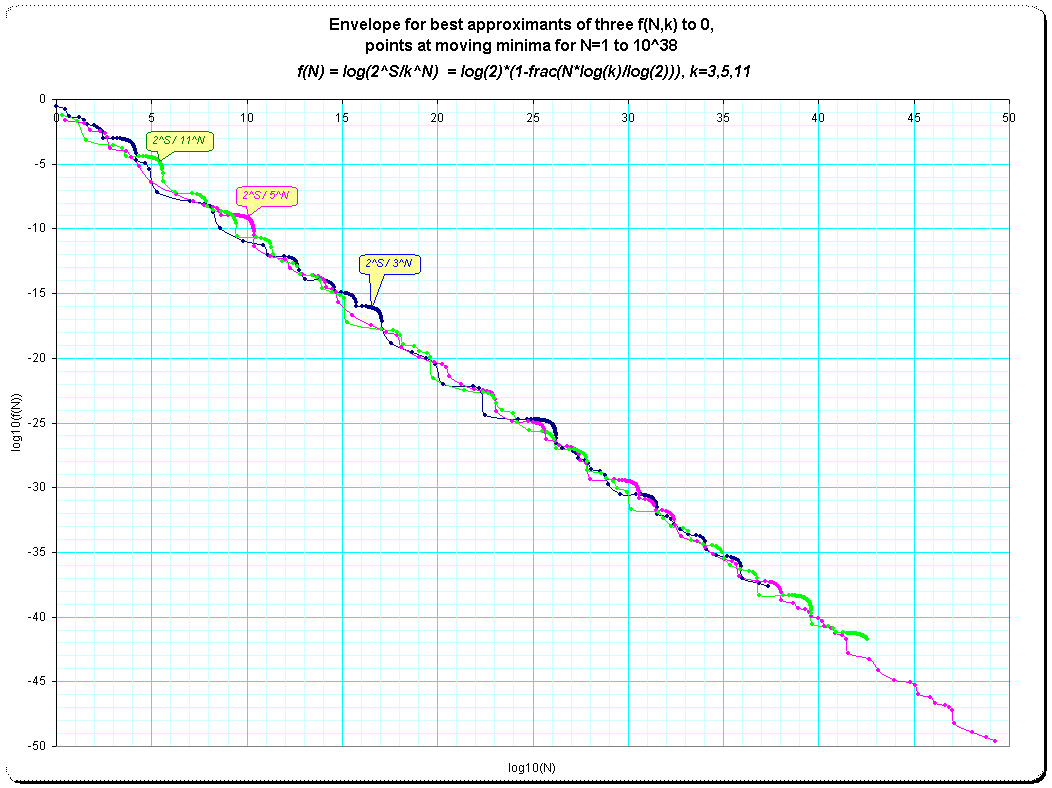
The longer line for k=5 indicates, that this configuration approximates faster to zero
To see the deviation from the trend (with slope –1) I rotate the whole plot by –45° :
Plot 4:Envelope-curves, rotated by 45°

The plot gives the impression as if the curves could be separated using fourier-analysis; but I don't have experience with this.
2.5. An earlier discussion in sci.math research (may 2004)
I took only the relevant posts, also shortened (or even removed) needless quoting of previous post and formatted text to special style. Use the google-link to look at the original posts.
|
http://groups.google.de/group/sci.math.research/browse_frm/thread/3fe481e4d991d6da/bdc7f0126c4c3e1a
newsgroups: sci.math.research Betreff: 3^n - 2^n and relatives |
|
Von: Gottfried Helms he...@uni-kassel.de Hi - I got an unequality, which i'm unable to analytically to disprove. Does anyone know useful related material? The inequality, formulating a restriction, arose whily studying the question of a certain, primitive assumed loop in the collatz (3x+1)-problem. Here it goes: 3^L - 1 powceil2( 3^L ) <= 2^L* ------- 2^L - 1 where powceil2 ( x) = smallest power 2^S >= x Empirically the lhs is always *greater* than the rhs (up to L=200) The benefit of this inequality is, that if it cannot be satisfied, then a primitive loop in the Collatz-problem cannot exist. One can reformulate this formula for instance to: 3^L 3^L - 1 powceil2( ---- ) <= ---------- 2^L 2^L - 1 or many other ways... I didn't find a definitve form, where I could directly conclude the impossibility of that inequality. Someone with an idea? Regards - |
|
Von: Gareth
McCaughan gareth.mccaug...@pobox.com
Gottfried Helms <he...@uni-kassel.de> writes: > I got an unequality, which i'm unable to analytically to disprove. > Does anyone know useful related material? > The inequality, formulating a restriction, arose whily studying > the question of a certain, primitive assumed loop in the collatz > (3x+1)-problem. Here it goes: > 3^L - 1 > powceil2( 3^L ) <= 2^L* ------- > 2^L - 1 > where powceil2 ( x) = smallest power 2^S >= x
According to theorems mentioned at the start of chapter 3 of Baker's "Transcendental Number Theory", the following is true. Let A1,
..., An >= 4 and B >= 2, and suppose that ...
Write F := b1 log a1 + ... + bn log an. Then either F=0 or |F| > B^-(C Q log Q), where Q = product(log Ak) and In particular, let n=2 and d=1; Then this says F
= |p log 2 - q log 3| for a constant C. C can be found explicitly. Baker's book doesn't give details of how, but they are out there in the literature. There have been advances in this area since Baker's book. (Search Google for "laurent mignotte nesterenko".) The value of C will still be much larger than you'd like :-). Anyway: if the inequality above (the one you want to prove can't happen) holds then you can find p,q with |F| <= 2^-p or something like that. And if F is small then p and q have to be somewhat similar in size. Now, if p^-C < F <= 2^-p then -C log p <= -p log 2, so p / log p <= C / log 2. So you can get an upper bound on the size of p. It may or may not be practical then to check all actual values of p up to there. A nasty back-of-envelope calculation using a version of Laurent-Mignotte-Nestorenko quoted in a paper I've found on the web suggests that actually you get some such bound as |F| >= exp(-17280) / p^(8640+1080 log p) where those numbers could doubtless be reduced by being less sloppy than I was, but probably not hugely reduced. So, that would lead to a contradiction when 2^-p
p^(8640+1080 log p) < exp(-17280) which is true provided p >= 298000 or thereabouts. So ... if I haven't botched the above in any way (which I probably have), you "only" need to check a few hundred thousand values of L. You'd do that in practice by calculating log 3 / log 2 with sufficient accuracy (plain ol' double precision should be fine) and looking to see how close to an integer you can get by multiplying it by an integer up to a few hundred thousand in size. -- Gareth McCaughan .sig under construc |
|
Von: Gareth
McCaughan gareth.mccaug...@pobox.com
I wrote: > According to theorems mentioned at the start of chapter 3 of Baker's "Transcendental Number Theory", the following is true. .. > So ... if I haven't botched the above in any way (which > I probably have), you "only" need to check a few hundred > thousand values of L. You'd do that in practice by calculating > log 3 / log 2 with sufficient accuracy (plain ol' double > precision should be fine) and looking to see how close to > an integer you can get by multiplying it by an integer > up to a few hundred thousand in size.
I just received some e-mail from a friend of mine who knows much more about number theory than I do, observing that (1) it's rather well known (to those who know such things, I suppose) that the 3n+1 conjecture itself follows from some sort of bounds on the approximability of log 3 / log 2 by rationals, and (2) that the required bounds are much tighter than those obtainable by methods of the sort I mentioned. So if Gottfried Helms's conjecture is strong enough to do much for the 3n+1 conjecture (I'm not sure what a "primitive loop" is, I'm afraid) then the argument I sketched probably has some big holes in it. Contrariwise, if I've somehow managed to break my perfect record of never posting anything to sci.math.research without at least one serious mistake, then Gottfried's conjecture probably doesn't imply anything very exciting about the Collatz conjecture. It's after midnight local time and I should be in bed, so I shan't attempt to determine which of the three possibilities - the third being that Gottfried and I are both right, and that Gottfried has found a way to make progress on Collatz with weaker inequalities than others have obtained -- is the truth. I'm just sounding a note of caution. :-) -- Gareth McCaughan sig under construc |
|
Von: Gottfried
Helms he...@uni-kassel.de
Gareth McCaughan schrieb:: > I wrote: >>According to theorems mentioned at the start of chapter 3 >>of Baker's "Transcendental Number Theory", the following is >>true. > .. >>So ... if I haven't botched the above in any way (which >>I probably have), you "only" need to check a few hundred >>thousand values of L. You'd do that in practice by calculating >>log 3 / log 2 with sufficient accuracy (plain ol' double >>precision should be fine) and looking to see how close to >>an integer you can get by multiplying it by an integer >>up to a few hundred thousand in size. > I just received some e-mail from a friend of mine who knows > much more about number theory than I do, observing that > (1) it's rather well known (to those who know such things, > I suppose) that the 3n+1 conjecture itself follows from > some sort of bounds on the approximability of log 3 / log 2 > by rationals, and (2) that the required bounds are much > tighter than those obtainable by methods of the sort I > mentioned. So if Gottfried Helms's conjecture is strong > enough to do much for the 3n+1 conjecture (I'm not sure > what a "primitive loop" is, I'm afraid) then the argument > I sketched probably has some big holes in it. Contrariwise, > if I've somehow managed to break my perfect record of > never posting anything to sci.math.research without at > least one serious mistake, then Gottfried's conjecture > probably doesn't imply anything very exciting about the > Collatz conjecture. It's after midnight local time and > I should be in bed, so I shan't attempt to determine > which of the three possibilities -- the third being > that Gottfried and I are both right, and that Gottfried > has found a way to make progress on Collatz with weaker > inequalities than others have obtained -- is the truth. > I'm just sounding a note of caution. :-)
Hmmm, the stated inequality results from a "primitive" loop, let me explain that. ---------------------
Assume the transformation T on an odd x with the parameter A y= T(x;A) being y= (3x+1)/2^A where A is the highest exponent keeping y integral (which is actually only a short form for multiple steps of the collatz-transformation, collecting all subsequent x/2 - operations) and allowing short form for recursive notation:
z= T(y;B) = T(T(x;A);B) = T(x;A,B) then a loop of, for instance, length 2 occurs, if z = T(x;A,B) = x
------------------------------------------ The occuring equations are under investigation in some articles, that I've come across (mostly via internet), and are obviously difficult to handle, but of high general interest, as I learned this way.
My first approach was to deal with any type of loop, the general form x = T(x;A,B,C,D,..M) = T(x;A,B,C,D,...,M,A,B,C,...M) = T(x;A,B,C...)... for what I've got some nice results, but still not in the form of a general formulation, which could, for instance, easily been transferred to 5x+1 and other classes of the problem. So I decided, first to investigate a somehow "primitive" loop. I assumed most primitive loop (besides the trivial one, which is in this notation 1 = T(1;2) = T(1;2,2) = T(1;2,2,2,2,2,2,...) ) for my purposes the type of loop, which starts with one or more ascending steps, and then descends in one step. These are the assumed loops of the form x = T(x;1,1,1,1,...,1,A) where immediately strong restrictions apply on A.
One reason why I assumed that type as somehow primitive, is, that any eventual loop can be expressed as a collection of ascending steps between descending steps, if the length 0 is allowed. So an arbitrary transformation, for instance y = T(x;1,1,3,1,4,2,1,1,3) can be segmented in y = T( T(T(T(T(x;1,1,3);1,4);2);1,1,3) and eventually I can use my tools, that I developed in the analysis of the "primitive" loop. ------------------------------------------------------------- If I analyse the transformation of length N z = T(x;1,1,1,1,...,1,A) where the number of ones is denoted as "L", and check, whether it is ever possible, that we find a solution in integers, where z equals x, I come to an expression of the right hand side of my inequality, that I stated her in my previous postings, which also reflects an *additional* restriction. With an arbitray 3-step-transformation, x' = T(x;A,B,C) with the length N=3, where x' should equal x (thus realizing a loop) with x,y,z, the intermediate values of each transformation, we can formulate a strong restriction on the exponents A,B,C: since y = (3x+1)/2^A , z = (3y+1)/2^B , x'=(3z+1)/2^C and x=x' assumed (to form a loop), we can write their product as (3x+1) (3y+1) (3z+1)
Rearranging this we have: (3x+1) (3y+1) (3z+1) 1 1 1 and obviously the range for the rhs is 3^3 .. 4^3 , so the sum of the exponents S=A+B+C must be an integer, which makes 2^S falling in between this range. 3^N
< 2^S <= 4^N
(this is valid for any length N of assumed loop)
Even more, this equation shows without any lengthy proof, that whenever the sum S is in general 2*N, then *all* parentheses on the rhs must take their maximum, and this is 4 for each of them. This restricts then all x,y,z to be 1 , which in turn restricts all A,B,C to be 2. Result: if S = 2*N then x = T(x;A,B,C,D...) only if A=B=C=D=...=2 and x = 1 ---------------- It also shows a widely unknown property of the loop-problem, that the values of x,y,z have *high bounds* - which is important, since often articles about the collatz-problem assume loops in "high number" areas, if they don't find a solution in small accessible values. That is definitely not true: the values of the members of an eventual loop are much restricted in values.
Since the trivial loop is not of interest, we only have to study the cases 2^S < 4^N and since 2^S must be at least the next power of 2 after 3^N we have the inequality powerceil2(3^N) <= 2^S < 4^N
Now from the expansion of the three transformations into explicit formulas we get possible S; and I observed, that they were *always* smaller than powerceil2(3^N) in my cases of primitive loops. The contributions here in sci.math.research , sci.math and by some private posts showed, that there is an *extremely* high likelihood, that this inequality never holds. However - that's still no proof, even not for this simple case.
----------------------------------------------------------
I think, I made the needed progress now by investigating some modular classes, which exhibited a useful, very simple structure for candidate numbers x and y. The above form of the inequality, stated for a "primitive" loop of length N with L=N-1 ones and one exponent >1 x = T(x;1,1,1,1,1....1,C) with L ones, C>1 and x odd integer>1 This problem can be separated into two: y = T(x;1,1,1,1,1,1...1) with L=N-1 ones ("iterated transformation") z = T(y;C) where z should equal x An iterated transformation like y=T(x;1,1,1,1,1....1) with L ones restricts x and y to a very specific modular structure. it comes out, that - with a free parameter i ranging of nonnegative odd integers - x and y *must* have a very simple structure depending on the length of the requested iterated transformation: x = i * 2 * 2^L -1 thus 3* ( i * 2 * 3^L
-1 ) +1 and if z = x 3* ( i*2*3^L -1
) +1
After rearranging I come to the equation i*3^N -1 and with S = C + 1*L the stated inequality must hold:
i*3^N -1
If this inequality does not hold, then such a type of loop cannot exist - irrespectively of any assumend length. ------------------------------------------------------- I stated this inequality for the case i=1 . For growing i the middle part of the inequality is better written like the following 3^N - 1/i and this converges to 3N, which is definitevely smaller than the lhs:
for i->oo the inequality powerceil2(3^N) <= 3^N is obviously false. So the case with i=1 was the most critical case, and I accept the information and learned the arguments for the extremely likelihood, that this inequality cannnot be satisfied for any parameter L and C but which is still not *proven*.... ------------------------------------------------------------------ If that's solved, then at least a "primitive" loop can be actually negated - which is surely no great step in the whole loop-problem or even the general collatz problem - but... it's a start. Therefore I'm also more interested in extensible proofs than in min/max-estimations for separate cases, if they cannot be generalized to other collatz-type-problems. ... Unfortunately, a disproof of this type of collatz-loops is not conversely saying something on the above inequality, insofar it concerns unproved assumtions about the 2-log of 3 and the like, what you and others had derived here - that's bad luck. But I've got the impression, that some of my equations in this context could be helpful for progress even in that regard. I'll post them, if I've time these days. Hope I answered the questions, that you rose in your post, even if I had difficulties to really follow your four segments today... :-) Regards - |
|
Von: Gottfried
Helms he...@uni-kassel.de Gareth McCaughan schrieb:: > According to theorems mentioned at the
start of chapter 3 of Baker's "Transcendental Number Theory", the
following is true. Hi Gareth - that's a very interesting material, thank you (hope, I'll ever learn to apply that myself). I'll study it in more detail next days, since I'm guessing another connection to that field here, where my derivations on number-structure possibly could give additional information - or at least some more insight - I'll post it another day. For an explanation for the origin of my question please see my other post. Regards - |
|
Von:
stei...@math.bgsu.edu (Ray Steiner)
Gottfried Helms <he...@uni-kassel.de> wrote in message <news:c94mv1$jl8$05$1@news.t-online.com>... > Am 24.05.04 01:00 schrieb Gareth
McCaughan: (…) I proved the nonexistence of a circuit in the 3x+1 problem in 1977. Is this what a "primitive cycle" actually is? A circuit is a cycle with one rise and one fall. In fact, B. deWeger has recently shown that there is no cycle in the 3x+1 rproblem with less than 69 rises and falls in it. I can actually extend this to 70 and 71 rises and falls with Rhin's inequality which I mentioned in an earlier post. Regards, |
|
Von: Gottfried
Helms he...@uni-kassel.de Am 01.06.04 19:48 schrieb Ray Steiner: > (…) Hmm, that's interesting. I called it a "primitive", if there are N-1 steps ascending and 1 step descending, like it is in (7->11->17) -> 13 which, written as an transfer only noting the occuring exponents-of-2 13 = T(7;1,1,4) My question was "is there any solution in integers
x,N,A with ". I found this very tight relation to the 3^N - 2^N properties, thus my question here. The case of only one-raise-one-fall, if that means x = T(x;1,A) would then just be a special case of my question and can be proven by enumeration or even modular arithmetic. But I would like to know, how you accessed the problem of this specific of rises&falls? I have a formula, how you can disprove a circle of *any* finite combination of raises&falls in finite number of tests, let say 100 raises&falls by a number Z of tests, where Z is a combinatorical function of about 42, which I'm bounding down by optimizing my formulas. My attempt was to generalize these formulas to *unlimited* Z. The "primitive" Loop is the most simple structure of that general problem of unlimited length, and has very tight and handy relations to the (3/2)^N - structure and that of frac( (3/2)^N), which I'm currently investigating. --------------------------- Concerning your reference to deWegner: His literature looks interesting, especially those with the focus on binomials: that was the next idea, that I wanted to step in. As I pointed out in a previor post the related problem can be represented using a rep-unit-form and the question, whether 3^n-1 div 2^N can ever be a repunit base a certain power of 2^P with p reasonably greater than N (don't have it at hand just now). I'm currently studying, what the binomial- expansion of 3^N = (2+1)^N explains for that problem. Just have seen your reference to Rhin: could you point to a reference? Regards - |
|
Von:
stei...@math.bgsu.edu (Ray Steiner) (…) There is a paper by Georges Rhin(1987) in which he proves that |p log 2 - q log 3| > H^(-13.3), where H = max(p,q) and After that, just check the convergents of log-2(3). Regards,
|
|
|